 Türkçe
 English
Create your Okito account and add the website you want to manage.
Home / UK GDPR
Get Started
Simplify Cookie Compliance Under UK GDPR
Manage website consent in line with UK GDPR and PECR requirements. Okito helps you identify cookies and tracking technologies, present clear choices, apply visitor preferences to configured scripts and maintain consent records from one platform.
Powering we provide the latest solutions for website privacy compliance



























Support UK GDPR and PECR Requirements
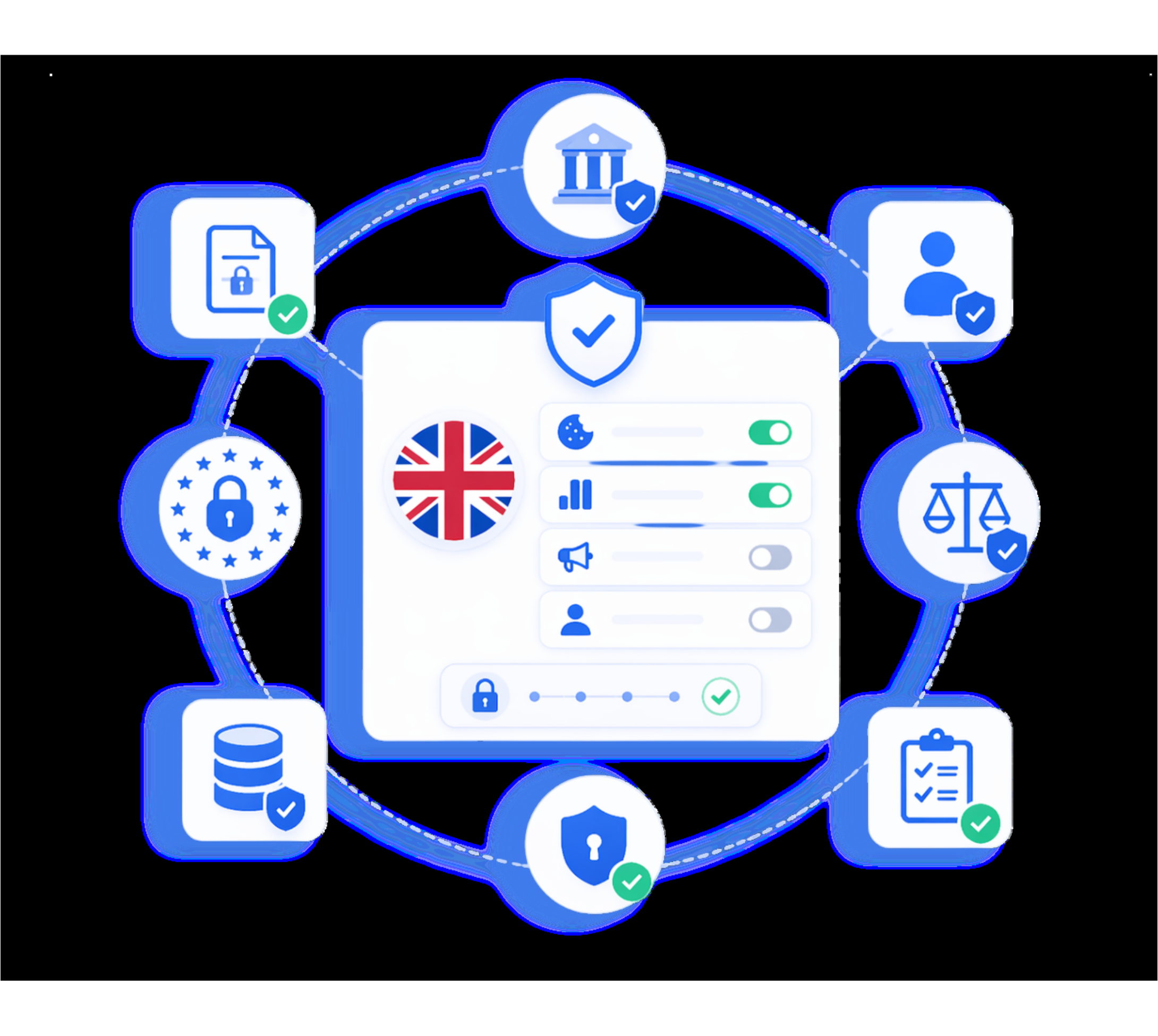
The UK GDPR governs how personal data is processed, while PECR contains specific rules for cookies and similar technologies. Okito brings cookie discovery, consent choices, preference management and consent records into a practical website workflow.
Apply Cookie Exceptions Accurately
Review detected technologies by purpose before deciding whether consent or a PECR exception may apply. Okito gives you the controls to configure analytics and functionality technologies individually rather than treating every cookie in these categories as automatically exempt.

Manage Consent Without Unnecessary Complexity
Run cookie scans, configure consent categories and monitor consent activity from a central dashboard. Okito helps you maintain a consistent consent experience while your website, vendors and tracking technologies change.

Key Requirements for UK GDPR Compliance with Okito
Collect Valid and Granular Cookie Consent
Okito helps you create a transparent cookie consent experience that supports UK GDPR requirements and gives visitors meaningful control over their data. Customisable banners explain available choices clearly without making the consent process unnecessarily complicated.
Inform visitors about the purposes of cookies, trackers and similar technologies before requesting consent.
Provide clear options to accept, reject or manage optional cookies by category.
Allow visitors to revisit their preferences and withdraw consent as easily as they gave it.
With granular preference controls, Okito helps you collect informed and unambiguous choices while maintaining a consistent experience across your website.
Apply UK Cookie Exceptions Carefully
Not every cookie requires consent under PECR. Okito helps you review detected technologies according to their purpose and configure the appropriate consent behaviour for each one.
Identify technologies that may be strictly necessary to provide a service requested by the visitor.
Configure limited statistical or appearance-related technologies according to the conditions that apply to their use.
Keep advertising, profiling and individual tracking technologies subject to consent where an exception does not apply.
The Data (Use and Access) Act 2025 updated the UK rules for cookies and similar technologies, while available exceptions remain conditional and purpose-specific. Okito gives you the controls to manage these technologies individually rather than treating every analytics or functionality cookie as exempt.
Control Consent-Dependent Cookies and Scripts
A consent banner should control the technologies operating behind it, not simply display information. Okito connects visitor preferences with the cookies, pixels, tags and third-party scripts configured on your website.
Scan your website to identify cookies, trackers, pixels and third-party scripts.
Organise detected technologies by category, purpose, provider and duration.
Prevent configured non-essential technologies from running until the required consent choice is made.
When a visitor accepts, rejects or changes a category, Okito applies that preference to the relevant configured technologies. This helps keep the consent interface and the website’s actual tracking behaviour aligned.
Maintain Consent Records and User Control
Cookie consent management continues after the banner is published. Okito brings consent activity, detected technologies and preference settings together in one central dashboard.
Record consent activity to support accountability, audits and internal compliance reviews.
Give visitors an accessible way to revisit, change or withdraw their cookie preferences.
Monitor newly detected cookies and review the setup when vendors or scripts change.
Scheduled scans help identify changes as your website evolves, while centralised consent records make ongoing consent management easier.
Simplify Your UK GDPR Compliance Today
Faq
Frequently Asked Questions UK GDPR Compliance
The UK General Data Protection Regulation (UK GDPR) is the United Kingdom’s main legal framework for processing personal data. It sets rules for how organisations collect, use, store, share and protect information relating to identifiable individuals.
The UK GDPR operates alongside the Data Protection Act 2018 and applies to both data controllers and data processors. The Data (Use and Access) Act 2025 amended parts of this framework but did not replace it. Organisations must process personal data lawfully, protect individual rights and be able to demonstrate compliance.
The seven UK GDPR principles establish the standards organisations must follow when processing personal data:
Lawfulness, fairness and transparency: Personal data must be processed lawfully, fairly and openly.
Purpose limitation: Data must be collected for specified, explicit and legitimate purposes.
Data minimisation: Only personal data that is adequate, relevant and necessary should be collected.
Accuracy: Personal data must be accurate and kept up to date where necessary.
Storage limitation: Identifiable personal data should not be retained for longer than necessary.
Integrity and confidentiality: Appropriate security measures must protect personal data against unlawful access, loss or damage.
Accountability: Organisations must take responsibility for compliance and be able to demonstrate it.
These principles apply throughout the personal data lifecycle, from collection and use to retention and deletion. ICO guidance on the data protection principles
The Information Commissioner’s Office (ICO) is the UK’s independent supervisory authority for data protection. It is responsible for enforcing the UK GDPR and other data protection and electronic communications laws within its remit, including the Data Protection Act 2018 and the Privacy and Electronic Communications Regulations (PECR).
The ICO can investigate complaints, conduct audits, issue enforcement notices and impose monetary penalties for certain breaches. However, responsibility for complying with the law remains with each organisation that controls or processes personal data.
The UK GDPR and EU GDPR share the same core principles and many of the same individual rights, but they are separate legal frameworks. The main differences include:
Regulatory authority: The UK GDPR is enforced by the Information Commissioner’s Office (ICO), while the EU GDPR is enforced by data protection authorities in EU member states.
Legal framework: The UK GDPR operates alongside UK legislation, including the Data Protection Act 2018 and amendments introduced by the Data (Use and Access) Act 2025.
International data transfers: The UK has its own rules and mechanisms for transferring personal data internationally.
Territorial scope: The UK GDPR and EU GDPR have separate territorial scopes, meaning an organisation may need to comply with both depending on where it operates and whose personal data it processes.
For organisations operating in both markets, compliance should be assessed separately under the applicable UK and EU requirements.
Cookies and similar technologies in the UK are primarily regulated by the Privacy and Electronic Communications Regulations (PECR). The UK GDPR also applies when these technologies process personal data.
For cookies that require consent:
Consent must be obtained before storing or accessing information on a user’s device.
Consent must be freely given, specific, informed and unambiguous.
Users must take a clear affirmative action to provide consent.
Users must be able to withdraw consent as easily as they gave it.
Consent choices should be reflected in practice, meaning non-essential cookies and tracking technologies should not operate before the required consent is obtained.
PECR includes specific exceptions for certain technologies and purposes, so not every cookie automatically requires consent. Website operators should assess each technology according to its purpose and the conditions of the applicable exception.
Not specifically. UK law does not prescribe a particular banner design or format. However, when cookies or similar technologies require consent, visitors must receive clear information and make a valid choice before those technologies are used.
A properly configured cookie banner provides a practical way to explain tracking purposes and allow visitors to accept, reject or customise optional technologies.
No. A cookie banner must be connected to the technologies operating behind it. An effective consent setup should:
Prevent non-exempt cookies and scripts from running before consent.
Apply visitor preferences to the relevant cookie and tracking categories.
Record consent activity to support accountability.
Allow visitors to change or withdraw consent easily.
Be reviewed when website technologies change.
Okito combines these functions in one consent management platform, from cookie scanning and script control to preference management and consent records.
The law does not require the exact label “Reject All”, but refusing non-exempt technologies should be as easy as accepting them.
A banner that makes acceptance significantly easier than rejection may not provide a genuinely free choice. Visitors should have a clear and equally accessible way to reject optional cookies and tracking technologies.
In limited circumstances. The Data (Use and Access) Act 2025 introduced an exception under PECR for certain storage and access technologies used solely for statistical purposes, subject to specific conditions.
This does not mean every analytics cookie is exempt. Organisations must assess the technology, its purpose and whether the conditions for the exception are met. Analytics used for advertising, profiling or other non-exempt purposes may still require consent.
Organisations should keep sufficient records to demonstrate that valid consent was obtained. Depending on the consent mechanism, records may include:
When consent was given or changed.
What the visitor accepted or rejected.
How the choice was collected.
Which consent information was presented.
Whether the visitor later withdrew or changed their preferences.
Okito records consent activity and visitor preferences in a central dashboard, helping organisations maintain an audit trail and support compliance reviews.
Yes. UK rules on storage and access technologies are not limited to traditional cookies. They can also apply to tracking pixels, link decoration, local storage, device fingerprinting, scripts, tags and similar technologies.
Organisations should therefore assess their wider tracking environment rather than relying only on a traditional cookie inventory.
The Data (Use and Access) Act 2025 amended PECR and introduced additional exceptions for certain uses of storage and access technologies.
Key changes include:
An exception for certain statistical purposes.
An exception for certain appearance or functionality preferences.
An exception relating to emergency assistance location data.
Changes to PECR enforcement and penalty provisions.
These exceptions are subject to specific conditions and do not provide general permission to use analytics, advertising or tracking technologies without consent.